
The battery is not the problem. The alternator is. A 200 Ah lithium dual battery bank in the back of a bakkie is no longer exotic. Fridge, freezer, inverter, camp lights, a laptop or two, and a few days off-grid without worrying about state of charge. The hardware is cheap enough and the chemistry is good enough. What has not changed is the alternator bolted to the front of the engine, and that is where most lithium dual battery builds quietly go wrong.
Lead-acid batteries protected the alternator by accident. A flat 100 Ah AGM will only ever draw 20 to 30 A no matter what you connect it to, because its internal resistance throttles it. Lithium has no such manners. A half-empty 100 Ah LiFePO4 battery will happily pull 100 A if the charger lets it, and a 200 Ah bank will take whatever the alternator can give, for hours, until the alternator cooks. A DC-DC charger is the device that sits between the two and says no.
This article covers how much to let through, why the number depends on engine rpm, and what the popular South African 4x4s can actually deliver.
What “150 A” on the alternator actually means
The rating stamped on an alternator is its hot output at high pulley speed, typically 6,000 alternator rpm. The alternator is geared roughly 2.5 to 3 times faster than the crank, so that rating only arrives at about 2,000 to 2,500 engine rpm. At a warm idle of 700 to 800 rpm it delivers somewhere between 40 and 60 percent of the rating, and less in a hot engine bay because copper resistance climbs with temperature.
| Engine rpm | Typical driving state | Alternator output, as % of rating | 150 A unit delivers | 100 A unit delivers |
|---|---|---|---|---|
| 700 to 800 | Idle in traffic, at a campsite | 40 to 55% | 60 to 80 A | 40 to 55 A |
| 1,200 to 1,500 | Sand, slow gravel, towing in low range | 70 to 80% | 105 to 120 A | 70 to 80 A |
| 2,000 to 2,500 | Open-road cruising | 95 to 100% | 145 to 150 A | 95 to 100 A |
| 3,000 plus | Hard driving | 100% (thermally limited) | 150 A | 100 A |
Out of whatever the alternator makes, the vehicle takes its share first. A modern turbodiesel bakkie with headlights, aircon blower, cooling fans cycling and the infotainment on draws 30 to 50 A on its own. An older pre-2010 vehicle draws 20 to 30 A. What is left is the headroom for the second battery, and at idle on a 100 A alternator that can be as little as 10 A.
Post-2015 vehicles add a further complication: the smart alternator. To save fuel the engine ECU drops charge voltage to 12.5 to 13.2 V once the start battery is full, and only lifts it on overrun or when the start battery needs it. That voltage is too low to push meaningful current into a lithium bank that wants 14.2 V, which is why a plain isolator or solenoid no longer works on a Hilux GD-6, a Ranger bi-turbo or a new D-Max. The DC-DC charger has to boost.
Why a lithium dual battery needs a leash
A LiFePO4 battery will accept charge at 0.5C or more: a 100 Ah battery happily takes 50 A, a 200 Ah bank 100 A. Its internal resistance is a few milliohms, so from a half-empty state it looks almost like a dead short to the alternator until it is nearly full. An AGM of the same capacity self-limits at roughly 0.2 to 0.3C and tapers off as its voltage rises.
The practical consequence is that lithium dual battery capacity in the back no longer tells you how much current the alternator will see. The charger does. Connect a 200 Ah lithium bank through a 50 A charger with no input limit and the alternator supplies 55 to 60 A, continuously, for the three hours it takes to fill. Add the vehicle’s own 40 A and a 100 A alternator is at its rating the whole trip, in a 40 degree engine bay, while idling through Kruger at 800 rpm. That is how alternators fail: not from a short, but from hours at full load with no airflow.
The example lithium dual battery for this article
The numbers that follow use a typical 12.8 V 104 Ah slimline LiFePO4 battery of the kind now going into lithium dual battery installs under rear seats and canopy floors. Its label is the whole argument in one place: it will take 100 A on charge, almost 1C, which is more than any standard bakkie alternator can safely give it.
| Rating | Value | What it means for the install |
|---|---|---|
| Nominal voltage | 12.8 V | Charge at 14.2 V absorption, 13.5 V float |
| Rated capacity | 104 Ah (1,331 Wh) | One unit runs a 60 L fridge for 3 to 4 days |
| Maximum charge current | 100 A (about 1C) | Would pull 110 A from the alternator with no limit set |
| Typical rated cycling point | 0.5C, about 52 A | Cycle-life figures are quoted at this rate; 30 A from the alternator is well inside it |
| Maximum discharge current | 200 A continuous | Runs a 2 kVA inverter; reverse-charges the start battery with ease |
| Surge discharge | 290 A for 30 s | Fuse the bank at 150 to 200 A |
| Operating temperature | −20 to 50 °C | Most LiFePO4 BMSs block charging below 0 °C; a Drakensberg or Karoo winter morning means no alternator charge until the bank warms. Check whether your battery has a low-temperature charge cut-off or self-heating |
| Cycle life | 6,000+ cycles | Daily cycling for the life of the vehicle |
Two settings in the charger, and which one protects the alternator

A modern DC-DC charger such as the Victron Orion XS has two independent current limits, both adjustable in VictronConnect from 1 A to the unit’s rating in 0.1 A steps:
- Output current limit caps what flows into the lithium bank. This is the charge rate.
- Input current limit caps what the charger draws from the alternator. This is the alternator protection, and the setting that matters most on a lithium dual battery.
They are not the same number. The charger boosts voltage from a smart alternator sitting at 12.6 V up to 14.2 V at the battery, and at 97 to 98 percent efficiency the input current is always 10 to 15 percent higher than the output. A 30 A output draws about 34 A from the alternator. If the alternator is what you are protecting, set the input limit; the output follows.
The rule of thumb for the input limit on any lithium dual battery install:
For a 150 A Hilux GD-6 with a 40 A vehicle load that gives 35 A. For a 100 A older D-Max or D-4D it gives 10 A, which is why those vehicles either run a modest 18 to 20 A charger or get an alternator upgrade. The 0.5 factor is the idle de-rating; if you never idle for long with the aircon on, 0.6 is defensible. Beyond that you are relying on driving at 2,000 rpm to keep the alternator alive.
Sizing the charger for a 100 Ah or 200 Ah lithium dual battery
The charge rate you want is set by the battery; the charge rate you may have is set by the alternator. The table builds the lithium dual battery bank from one or two of the 104 Ah example units in parallel, which is the standard dual-battery and the standard upgrade. It assumes a 150 A smart alternator (Hilux GD-6, Ranger bi-turbo, Fortuner, new D-Max) and a 40 A vehicle load, so a 35 A input ceiling. Driving time is to recover from 50 percent state of charge, excluding absorption.
| Bank | Battery’s own charge limit | Charger | Program: output limit | Program: input limit | Draw on alternator | Drive time 50% to 100% | Cable, engine bay to tub (6 m) |
|---|---|---|---|---|---|---|---|
| 1 × 10⁴ Ah (1.3 kWh) | 100 A | Orion XS 12/12-50 | 30 A | 35 A | 34 A | 1.7 h | 16 mm² |
| 2 × 10⁴ Ah = 208 Ah (2.7 kWh) | 200 A | Orion XS 12/12-50 | 30 A | 35 A | 34 A | 3.5 h | 16 mm² |
What changes the picture
Notice the charger column barely changes, and the battery’s own 100 A-per-unit charge limit never comes into play. From the first unit onward the alternator is the bottleneck, not the charger or the battery, and buying a bigger charger only lets you set a limit you then cannot use. Three things change that picture:
- Solar does the bulk work. A 200 Ah bank with 200 to 300 W on the roof or a portable panel only needs the alternator for a top-up, and 30 A is plenty.
- An alternator upgrade. A 200 to 250 A unit on a 79-series Cruiser or an older Hilux lifts the input ceiling to 60 to 80 A, at which point a second Orion XS in parallel, or an XS 12/12-70, makes sense.
- Shorter stops. A 200 Ah bank that gets 3 to 4 hours of highway driving every two or three days will recover fully even at 30 A. One that sits in camp for a week and then drives 40 minutes to the next camp will not, whatever charger is fitted.
South Africa’s common 4x4s: what the alternator can give
Idle headroom is the alternator’s idle output (taken as 50 percent of rating) minus a typical vehicle load (40 A on post-2015 vehicles, 30 A on older ones). The input-limit column is the number to program into the lithium dual battery charger in VictronConnect. Ratings marked * are approximate, from parts-catalogue cross-references rather than a manufacturer page, and vary by trim and year; check the sticker on your own alternator.
| Vehicle | Engine | Years | Alternator | Smart alternator | Idle headroom | Recommended charger | Program input limit |
|---|---|---|---|---|---|---|---|
| Toyota Hilux / Fortuner GD-6 | 2.4 / 2.8 1GD, 2GD | 2016 on | 150 A (100 A some 2.4 base)* | Yes | 35 A | Orion XS 12/12-50 | 30 to 35 A |
| Toyota Hilux D-4D | 2.5 / 3.0 KD | 2005 to 2015 | 100 A | No | 20 A | Orion-Tr Smart 12/12-18 or XS at 20 A | 18 to 20 A |
| Toyota Land Cruiser 79 V8 | 4.5 1VD-FTV | 2007 on | 130 A | No | 35 A | Orion XS 12/12-50 | 30 A |
| Toyota Land Cruiser 79 / 76 | 4.2 1HZ | 1990s on | 80 A* | No | 10 A | Orion-Tr Smart 12/12-18, or upgrade alternator | 10 to 15 A |
| Toyota Land Cruiser Prado 150 | 2.8 1GD / 4.0 V6 | 2015 on | 150 A* | Yes | 35 A | Orion XS 12/12-50 | 30 to 35 A |
| Ford Ranger / Everest T6 | 2.2 / 3.2 TDCi | 2011 to 2022 | 110 A (150 A on some trims) | Yes | 15 A | Orion-Tr Smart 12/12-18 or XS at 20 A | 15 to 20 A |
| Ford Ranger / Everest | 2.0 SiT / BiT | 2019 on | 150 A* | Yes | 35 A | Orion XS 12/12-50 | 30 to 35 A |
| Ford Ranger next-gen / Raptor | 2.0 BiT, 3.0 V6 | 2022 on | 180 to 250 A by engine | Yes | 50 to 85 A | Orion XS 12/12-50 (two in parallel on V6) | 45 to 50 A |
| Isuzu D-Max / KB | 2.5 / 3.0 4JJ1 | 2007 to 2020 | 80 to 90 A | No | 10 to 15 A | Orion-Tr Smart 12/12-18 | 12 to 15 A |
| Isuzu D-Max / mu-X | 3.0 4JJ3 | 2021 on | 130 A* | Yes | 25 A | Orion XS 12/12-50 at 25 A | 25 A |
| Nissan Navara | 2.3 / 2.5 | 2013 on | 150 A* | Yes | 35 A | Orion XS 12/12-50 | 30 to 35 A |
| VW Amarok | 2.0 BiTDI / 3.0 V6 | 2011 to 2022 | 140 to 180 A* | Yes | 30 to 50 A | Orion XS 12/12-50 | 30 to 45 A |
| Mitsubishi Triton / Pajero Sport | 2.4 MIVEC | 2016 on | 130 A* | Yes | 25 A | Orion XS 12/12-50 at 25 A | 25 A |
| Mahindra Pik Up | 2.2 mHawk | 2017 on | 100 A* | No | 20 A | Orion-Tr Smart 12/12-18 or XS at 20 A | 20 A |
| GWM P-Series | 2.0 TD | 2020 on | 120 A* | Yes | 20 A | Orion XS 12/12-50 at 20 A | 20 A |
| GWM P300 | 2.4T diesel, 135 kW / 480 Nm, 9AT | 2024 on | 150 A* | Yes | 35 A | Orion XS 12/12-50 | 30 A, confirm against the alternator sticker |
| Suzuki Jimny | 1.5 K15B | 2018 on | 70 A* | No | 5 A | Orion-Tr Smart 12/12-9, small bank only | 8 to 10 A |
Reading the table
The pattern is plain. Anything with a 150 A or larger alternator can run a 50 A-class charger limited to 30 to 35 A and feed a 100 to 200 Ah lithium dual battery comfortably. Anything under 110 A should stay at or below 20 A, which realistically means a 100 to 200 Ah lithium dual battery unless solar is doing the heavy lifting or the alternator is upgraded. The 1HZ Cruiser and the Jimny are the two that need a conversation about expectations before the battery is bought.
The GWM P300 is the newest entry: GWM’s South African brochure lists the 2.4T engine, 9-speed automatic, roof power supply and trailer outlet, but not an alternator rating, so the 150 A figure is a class estimate for a 2024 Euro-5 turbodiesel with ECU-controlled charging. Treat it as a smart-alternator vehicle and start at 30 A until the sticker says otherwise.
Which charger
For a 150 A-class vehicle with a lithium dual battery the Victron Orion XS 12/12-50 is the default: 50 A capacity, input and output limits adjustable from 1 to 50 A, 98.5 percent efficiency, fanless, IP65, and Bluetooth setup (full specifications on the Victron Energy Orion XS page). Set the input limit at 30 to 35 A on day one and lift it later if you upgrade the alternator or add a second unit in parallel.
| Charger | Output | Input limit adjustable | Best for | Note |
|---|---|---|---|---|
| Orion XS 12/12-50 | 50 A | 1 to 50 A | 150 A alternators, 100 to 200 Ah lithium | The one to buy for a GD-6, Ranger, Navara, Cruiser V8; reverse-charges the start battery from v1.15 |
| Orion XS 1400 | 50 A (1,400 W only at 24 V out) | 1 to 50 A | 24 V trucks or 24 V house banks | Same 50 A as the 12/12-50 on a 12 V bakkie; buy it only if 24 V is in the picture |
| Orion XS 12/12-70 | 70 A | 1 to 70 A | Upgraded 200 A-plus alternators | IP20, so inside the cab or canopy, not the engine bay |
| Orion-Tr Smart 12/12-30 | 30 A | Not adjustable (fixed) | Older design, still common in SA fitment centres | No input limit; relies on its 30 A ceiling as the protection |
| Orion-Tr Smart 12/12-18 | 18 A | Not adjustable | 80 to 110 A alternators, 100 Ah banks | Right size for a D-4D, older D-Max or Mahindra |

Paralleling and alternator upgrades
Two Orion XS units in parallel give 100 A for a 200 Ah bank on an upgraded alternator; Victron supports unlimited paralleling. For the 1HZ Cruiser and other sub-100 A vehicles the honest advice is that a 200 A aftermarket alternator costs about the same as a second charger and solves the problem at the source.
New in firmware v1.15: the lithium bank can now start the vehicle
The current flow is no longer one-way. Victron’s Orion XS firmware v1.15, paired with VictronConnect v6.43, adds an emergency reverse charge function across the whole range: the 12/12-50, the 12/12-70 and the 1400. If the start battery is too flat to crank, the charger temporarily reverses direction and feeds it from the auxiliary bank. For a 4×4 with a 100 to 200 Ah lithium dual battery in the back, that turns the lithium dual battery into a built-in jump pack and removes one of the stronger arguments for a traditional solenoid-linked system.
How it works
- Started from the VictronConnect Status screen by tapping the new engine-starter charge icon.
- Runs for 15 minutes, then stops for a 5-minute settling period with the charger disabled. The engine is cranked during the settling period.
- Only available once forward charging has stopped: when input voltage lockout is active or the Orion XS has detected engine shutdown. It also works in the remote-off state, so an ignition-wired H pin does not block it.
- Charges the start battery to a maximum of 14.4 V (28.8 V on an XS 1400 set to a 24 V starter).
- Reverse current is the lower of the configured current limit or half the device rating, so 25 A on an XS 12/12-50. It tapers if the auxiliary bank’s voltage drops too far.
- The XS 1400 gets a new 12 V / 24 V starter-battery setting; VictronConnect prompts for it the first time the feature is used if it has not been set in Product Settings.
Two practical notes for the lithium dual battery install
First, the input current limit you programmed to protect the alternator is also the ceiling for reverse charging, so a 30 A input limit gives 25 A into the start battery, which over 15 minutes puts roughly 6 Ah back, more than enough to crank a warm diesel. Second, the function depends on the auxiliary bank’s BMS allowing discharge at that current and temperature; the example battery’s 200 A continuous discharge rating and −20 °C discharge floor leave a wide margin, and the feature works even on a morning too cold for the bank to accept charge.
The update installs through VictronConnect, remotely via VRM, or from Victron Professional. Victron describes this as the first of several reverse charging features planned for the Orion XS, so the architecture is worth building around.
Fusing, cable and the lithium dual battery parts list
Fuse size
For a Hilux GD-6 lithium dual battery install with the Orion XS 12/12-50 limited to 30 to 35 A input, fuse both ends of the run with a 60 A MEGA-fuse and wire it in 16 mm². The Orion draws about 35 A at the input limit and reverse-charges at a maximum of 25 A; 60 A sits above both without nuisance-blowing on inrush and still protects the cable. Victron does not list a 50 A MEGA, and 40 A is too close to a 35 A continuous load in a hot engine bay.
If the alternator is upgraded and the input limit lifted toward 50 A, step up to the 80 A MEGA (CIP138080020) in the same holder.
Cable size
The Orion XS terminals accept 16 mm² at most, so that is the cable at the unit. At 35 A over a 6 m run (12 m loop) the drop on 16 mm² is about 0.5 V, which the boost stage absorbs. Only on a run past 8 m is 25 mm² worth it for the main length, stepped down to 16 mm² tails at the charger. M8 lugs at the holders and the batteries.
The auxiliary-end fuse
The 60 A MEGA beside the auxiliary battery protects the Orion branch in both directions, including the reverse-charge path back to the start battery. If that battery also feeds an inverter or a distribution panel, that is a separate circuit with its own main fuse sized to the battery’s 200 A discharge rating: a 150 A or 200 A MEGA (CIP138150020 or CIP138200020) in a third holder, or a Lynx Distributor if you are building a proper DC bus. And mount the engine-bay holder as close to the start battery post as practical, because the length between post and fuse is the one piece of cable nothing protects.
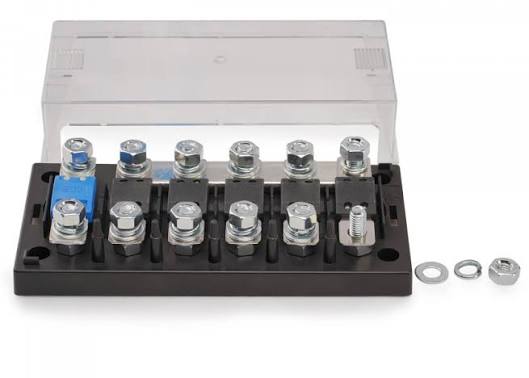
| Item | Qty | Part number | Where it goes |
|---|---|---|---|
| Orion XS 12/12-50 A DC-DC charger | 1 | ORI121217040 | Close to the auxiliary battery |
| MEGA fuse holder | 2 | CIP000100001 | One at the start battery positive, one at the auxiliary battery positive |
| MEGA-fuse 60 A / 80 V | 2 plus 1 spare | CIP138060020 | One in each holder |
| SmartShunt 500 A / 50 mV IP67 (optional) | 1 | SHU065150050 | Auxiliary negative; gives the Orion true battery voltage and temperature over VE.Smart Networking |
| Battery cable 16 mm², red and black | about 14 m | automotive grade, local supply | Engine bay to tub plus tails |
| Cable lugs M8, 16 mm² | 8 | local supply | Both ends of each run |
| Ignition-switched wire 1.5 mm² | about 6 m | local supply | To the Orion H pin |

Lithium dual battery installation and programming checklist
- Read the alternator sticker or part number and confirm its rating; do not assume from the model
- Mount the charger as close to the auxiliary battery as practical; it tolerates low input voltage better than long output cable
- Cable: 16 mm² for a 30 to 35 A limit over a 6 m run; 25 mm² only for runs past 8 m or limits above 40 A, stepped down to 16 mm² at the charger terminals
- 60 A MEGA-fuse in a MEGA holder at both ends of the charger run; a separate 150 to 200 A main fuse at the bank if it also feeds an inverter or loads, sized to the 200 A discharge and 290 A surge rating rather than to the charger
- Wire the remote H pin to an ignition-switched feed on any smart-alternator vehicle; alternator-voltage detection alone is unreliable
- In VictronConnect set the battery preset to LiFePO4 (14.2 V absorption, 13.5 V float), then set the input current limit to the value from the vehicle table
- Set the output limit at or below the lithium BMS continuous charge rating (100 A per unit on the example battery, so the alternator limit always governs)
- Enable engine shutdown detection on “remote” rather than input voltage
- Check charger temperature after the first hour of driving in summer; the XS de-rates 1.5 percent per degree above 40 °C
- If a SmartShunt or BMV is fitted, enable VE.Smart Networking so the charger sees true battery voltage and temperature
- Update the Orion XS to firmware v1.15 or later and VictronConnect to v6.43 or later, then test the emergency reverse charge once in the driveway, not for the first time in the bush
The short version
Take half the alternator’s rating, subtract 40 A, and that is the input limit for your lithium dual battery. On a 150 A alternator that is 35 A; on a 100 A alternator it is 10 A. Buy the lithium dual battery you need for the time you spend in camp, buy a 50 A-class charger with an adjustable input limit, and program that number before you connect the battery. The alternator does not know whether there is 100 Ah or 200 Ah in the back. Only the charger does, and only if you tell it.
Sources
- Victron Orion XS 1400 specification, Bimble Solar
- Orion XS range and paralleling, Current Connected
- Orion XS 1400 overview, Solar4RVs
- Hilux 1KD-FTV 100 A alternator, Jaylec
- Land Cruiser 1VD-FTV 130 A alternator, 70 Series Store
- Ranger T6 110 A alternator, Autodoc
- Ranger next-gen 250 A alternator, Jefferson Ford Parts
- Isuzu D-Max 4JJ1 90 A alternator, eBay
- Ranger smart alternator, CarsGuide
- Navara smart alternator thread, 4x4community.co.za
- Hilux GD-6 alternator voltage thread, 4x4community.co.za
- Victron Energy, “Orion XS firmware v1.15 – Emergency reverse charge”, Victron Professional newsletter, forwarded 2026
- GWM P300 range brochure, July 2025 (PDF)
- GWM P300 2.4T double cab LT 4×4 specifications, cars.co.za
- Victron Energy South Africa distributor catalogue, Q3 2026: Orion XS, MEGA-fuses and holders, SmartShunt part numbers, supplied by the author

